The citrus trees for sale on this site are all cold resistant, from -8 C to -16 C for the most rustic.
The rootstocks used offer the best combination of frost resistance and vigor.
The grafts were taken from mother trees that have endured intense outdoor cold waves, most of them from nurseries or farmers, sometimes from private gardens. Their selection is the result of meticulous observations throughout the decades, by gardeners with an attentive eye, but also of multiple exchanges between enthusiasts. All these mother trees were grown in the open ground, with a good exposure, protected from strong winds, well fed and irrigated.
The hardiness levels remain indicative and apply to adult trees in dormancy in the middle of winter, in a sheltered situation.
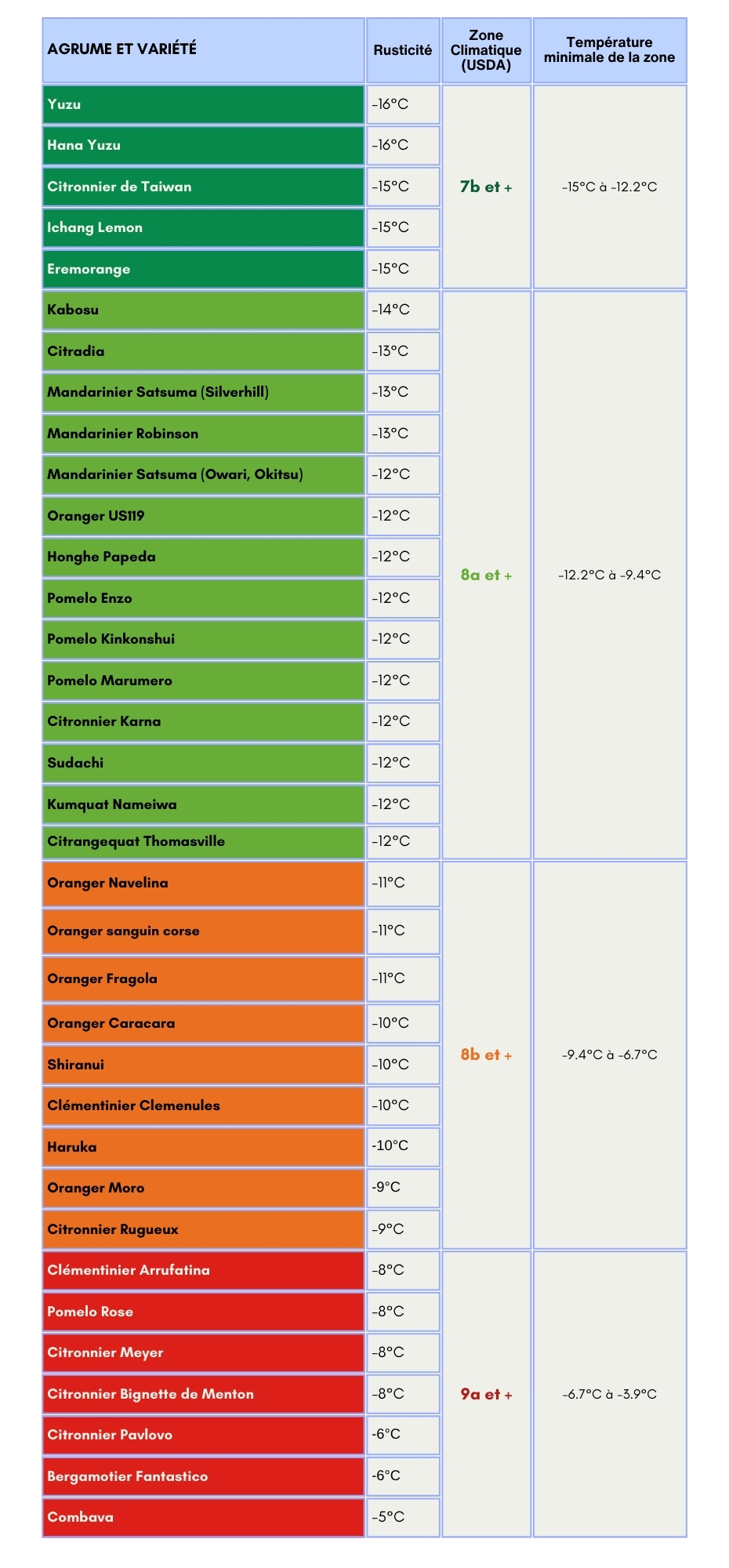
USDA climate zones (U.S. Department of Agriculture) indicate the thermal minima observed over the last 30 years.
Swiss climate zones range from 5a (coldest) to 9a (warmest).
Hardiness ratings are given for mature trees in the ground and in wind‑protected situations, for intense but brief frosts.
Trees can withstand night frosts, mêe several nights in a row, provided daytime temperatures rise to at least 4 or 5 degrees above zero.
It’s the wood, the trunk and the main branches that ensure resistance to severe cold.
Trees exposed to strong and prolonged frost can suffer damage to young shoots.
In this case, prune the small damaged branches just before spring; they will regenerate with the first growth in April‑May.
An exceptional cold snap is always possible, causing lesions on secondary branches.
A more drastic pruning will then be required for a good restart.
For young trees, when heavy frosts are forecast, add or reinforce mulching.
It is possible to install a non‑woven fabric screen (TNT), but it must be removed as soon as the cold snap has passed. Be careful the screen must not touch the leaves; install it on four stakes planted around the young tree.
To find out which varieties you can plant in your area, first check your USDA climate zone
To find the nearest city, please visit the site:
https://www.plantmaps.com/interactive-switzerland-plant-hardiness-zone-map-celsius.php
The interactive map allows you to zoom in on your town and identify the USDA climate zone of the planned planting.
For a detailed view of thermal minima measured since 1991, please consult the following link:
Weather Switzerland - Temperature
Click on the nearest weather station to access the data by selecting “Comparison with climate data”.
USDA climate zones are defined by the minimum temperatures reached during the year (usually in January or February).
However, in a given region, minimum temperatures can vary significantly, sometimes over a few kilometres or even just a few hundred metres.
Factors that positively influence minimum temperatures include, for example:
A southern exposure greatly reduces minima and their duration
A sheltered area will gain warmth, and extreme cold will be shorter there
A sufficiently large water body will buffer and shorten cold periods.
In cities and suburbs, the urban heat island effect reduces nightly minima by several degrees in winter.
These factors can combine to create micro‑climates 8a/8b (-12.2 C à – 6.7 C) in the heart of a 7a/7b region (-17.8 C à -12.2 C).
To guarantee an optimal growth to a citrus tree it is necessary to install it in a place sheltered from the wind, well exposed to the sun especially in the morning.
You can plant near a house without fear, the main root of a citrus tree will plunge vertically into the ground. No risk for the foundations. The horizontal surface roots are not penetrating. The heat radiated by the walls will make you gain several degrees.
A dense hedge or a perimeter wall will also have a moderating effect on the extremes.
If you're planting in an orchard, don't space the trees too far apart.
Check the recommended planting distance in the description of the citrus fruit of your choice.
A citrus tree will only express its full potential if it is planted in the ground.
If the minimum temperatures in your region do not allow it for the varieties you have chosen, you will have to keep them in pots.
Trees will lose some of their hardiness by staying in a pot. In a classic pot, with rigid walls, the roots are concentrated against these walls and will be very exposed to frost.
In an Air-Pot, the roots are distributed throughout the volume and will be more protected. In this case, the loss of resistance to the cold can be estimated at 5 to 6 degrees.
The best solution is to shelter them over winter in a greenhouse maintained between a minimum of -5 degrees (at night) and a maximum of +10 to +15 degrees (during the day), then take them out in spring.
Alternatively, surround the pot with a double layer of thick jute. Add thick mulch to the soil around the pot. If the size of the tree allows it, apply a TNT veil of 19gr/m2 (minimum) without sticking it on the leaves. Use 4 sticks to build a box around the plant, keep the veil on the ground with large rocks or bricks.
All the trees sold on this site are raised in Air-Pots (see the manufacturer's website), specially shaped pots that guarantee the integrity of the roots in the long term.
As the tree grows, it should be transplanted to a larger Air-Pot. In theory there is no limit to the size of the Air-Pots, the system being designed to be expandable. In practice, it will become difficult to move the trees quickly because of their weight. A reduction pruning each year will therefore be unavoidable, unless you can plant directly in the greenhouse.
Note:
Don't throw the Air-Pots away. You can reuse them or return them to us.